
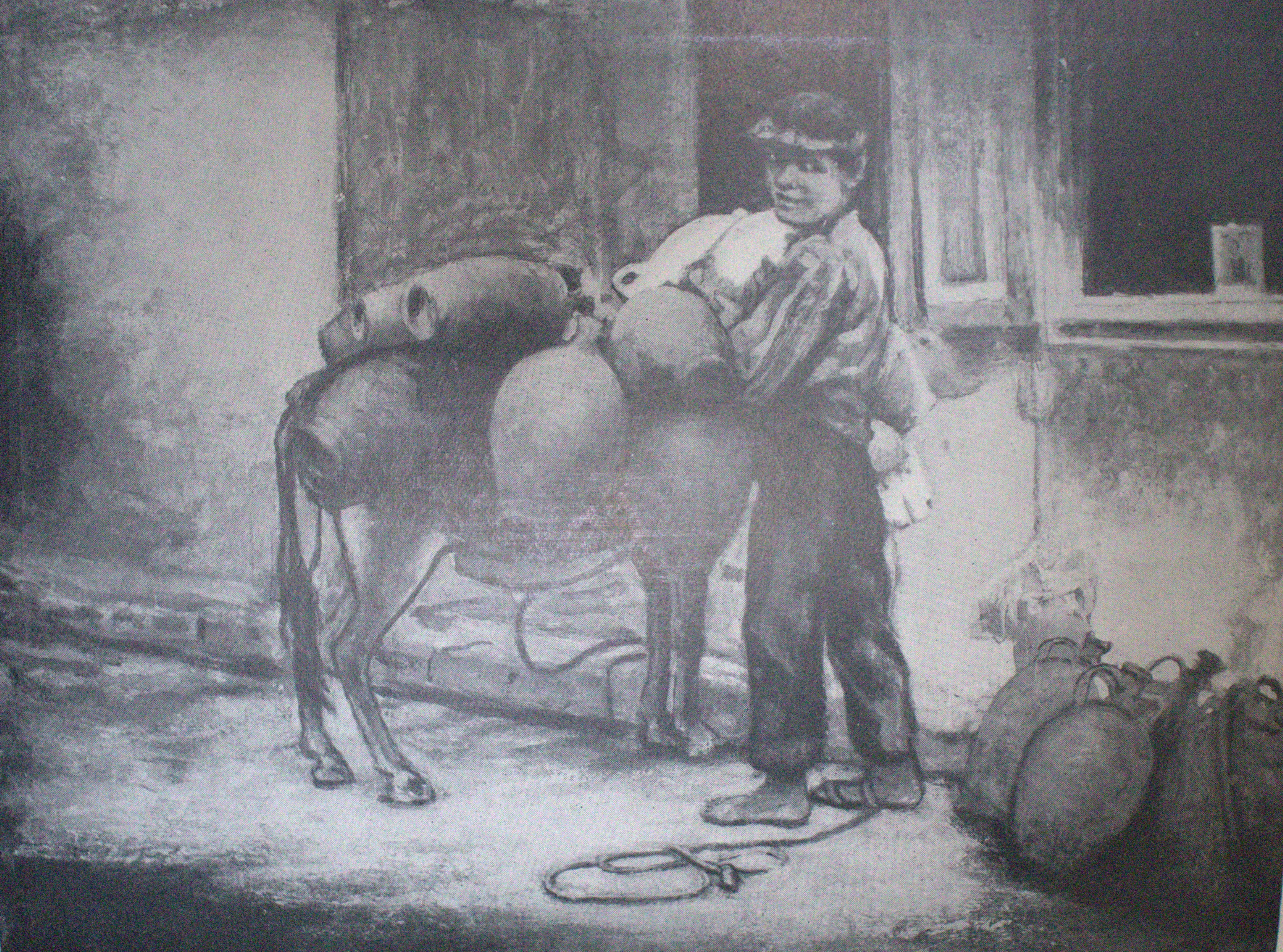
Emilie Isabel Russell Barrington, 'Street Scene in Athens: Boy Loading Donkey with Jars,' Through Greece and Dalmatia (1912), 32.
Traveling can always be a bit stressful and hectic, but imagine trying to trek across oceans, mountains, islands, deserts, and wild forests without our modern-day luxuries! The women featured in this exhibit consciously travel off the beaten path for even the eighteenth and nineteenth centuries, at times when the “Grand Tour” itinerary popular with young men was changing by the decade due to conflicts reshaping the Greek world. Access to the area was primarily limited to upper class women who could afford to hire a local guide on the long journey and draw up a travel permit for their itinerary. The most prepared among them–some traveling with an entourage–still frequently ran into trouble with language barriers, unfamiliar local customs, rustic accommodations, unforeseen travel conditions, and “robbers” and “bandits” in the rural countryside. Not to mention, these women also faced the realities of traveling as a solo gendered subject in a deeply misogynistic cultural setting. However, determined to share their stories and prove to their readers that women could see the world, each author included some of her most pressing travel tips to make the trip more comfortable and safe for future women on the road.
1) Brush up on modern Greek!
“For his own comfort and interest, any one travelling in Greece without a dragoman should certainly have a slight acquaintance with modern Greek, not but that I believe a traveller with a good temper and a sense of the ridiculous could get through the Peloponnesus on three words--krassi (κρασί), wine, psomi (ψωμί), bread, kala (καλά), good, beautiful, &c.” — Isabel Armstrong, Two Roving Englishwomen in Greece (1893), 1-2
2) Make sure you dress for the changing altitude and weather... Greece can get cold!
“Take plenty of warm clothing for the mountains, and thick shady hats, as in any other hot country.” — Emily Ann Smythe, The Eastern Shores of the Adriatic in 1863: With a Visit to Montenegro (1864), 61
“No traveller in Albania should omit taking a good blanket or two, or, what is better, a Zante quilt (a double counterpane, wadded with cotton wool), and certainly some kind of mattress to sleep on.” — Emily Ann Smythe, The Eastern Shores of the Adriatic in 1863: With a Visit to Montenegro (1864), 7
3) And of course, it can also be sweltering... stay cool any way you can!
“On a warm summer’s night, the deck passengers on board these boats always appear very enviable [...] They look so cool and comfortable there, that on one occasion I determined to make the experiment, and can safely recommend it to all who prefer space and fresh air to the stifling atmosphere of a crowded cabin.” — Mary Adelaide Walker, Through Macedonia to the Albanian Lakes (1864), 8
“I retreat to the balcony, shaded by thick vine-garlands, and enjoy, in delightful contrast with the glaring plain, what in the East is emphatically known as one form of ‘kief’—rest in cool shade, beside running water. You must live in the East to appreciate the importance of water in an Eastern's conception of rural enjoyment ; they will take you through a beautiful garden, such as that of Hamid Bay, near Canea; but the rich and glowing blossoms, the tropical plants and shrubs, are, to them, as nothing compared to the ‘havouz’—a square tank of rather muddy water in front of a small pavilion.” — Mary Adelaide Walker, Old Tracks and New Landmarks (1897), 245-6
4) Always be prepared for sickness and emergencies, and stay safe in a foreign country!
“You may believe I had a great mind to land on the fam’d Peloponessus, tho’ it were only to look on the rivers of Asopus, Peneus, Inachus and Eurotas…But instead of Demi-gods and Heroes, I was credibly informed, ’tis now overrun by robbers, and I should run a great risque running into their hand by undertaking such a journey through a desert country…” — Mary Wortley Montagu, Turkish Embassy Letters (1763), Vol.3, 68-9
“The sallow cheek and bloodless lip are a constant proof that even the most careful diet and regular living will not ensure safety; and so tenacious is this disorder that it often reappears at intervals during several years, notwithstanding change of air and climate. Sometimes the exhaustion from these repeated attacks proves fatal, but such cases are rather the exception than the rule. The Salonica fever is so much dreaded in Turkey, that many persons hesitate even to take a journey there during the unhealthy season. We had procured a good supply of quinine before venturing on the expedition.” — Mary Adelaide Walker, Through Macedonia to the Albanian Lakes (1864), 35
5) Get a good night's sleep, so you are rested enough for tomorrow's adventures!
“Portable bedsteads are indispensable for ladies and advisable for gentlemen. There are snakes, etc. and plenty of damp in Albania, which should be avoided by something better than a waterproof sheet or a cork mattress.” — Emily Ann Smythe, The Eastern Shores of the Adriatic in 1863: With a Visit to Montenegro (1864), 61
“Though I carried my own bed with me, I could not sometimes find a place to set it up in; and I rather chose to travel all night, as cold as it is, wrapped up in my forms, than to go into the common stoves, which are filled with a mixture of all sort of ill scents.” — Mary Wortley Montagu, Turkish Embassy Letters (1763), Vol.1, 79
“About half an hour after ten last night I ordered my servants not to have the horses put to, as I intended to sleep; for the only thing in which I am a bad traveller is, that I cannot go to sleep while the carriage is in motion.” — Elizabeth L. Craven, A Journey Through the Crimea to Constantinople (1789), 164